Saturday, April 11, 2009

Snakes In India

Of the over 2000 species of snakes in the world, about 200 are found in India. These range from the worm snakes having a length of about 10 cms. to those more than 6 mts. long. They live in almost all habitats from the warm seas to semi-deserts, swamps, lakes and even in the Himalayan glaciers up to an elevation of about 5000 mts. Thirty main species of Indian snakes have been discribed here.

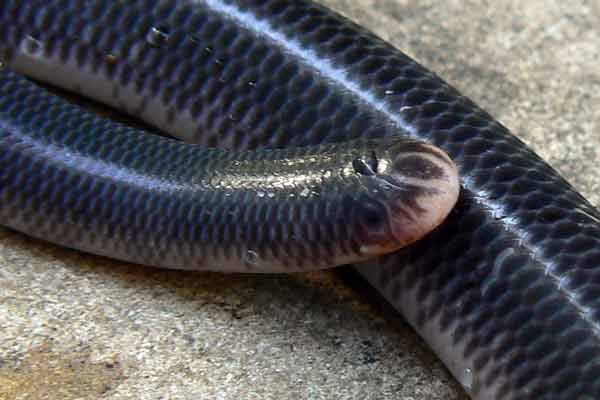
Common Worm Snake
( Typhlina bramina): A small worm-like snake found all over India. In the hills, it lives up to an elevation of 1000 mts.


Perrotet's Shield-tail Snake
(Plectrurus perroteti): A small snake found in the hills along the west coast of India, i.e., The Western Ghats, Nilgiri and Annamalai hills.


Indian Rock Python
(Python molurus): A large thick-bodied snake found in many parts of India. It ranges from the mangrove forest to arid scrublands and dense rain forest of the eastern Himalayas up to an elevation of about 2000 mts.


Common Sand Boa
(Eryx conicus): A short thick-bodied snake found in the plains and low hills of India. They are nocturnal and hunt after dark.


Red Sand Boa
(Eryx johnii): A medium-sized snake with a very blunt tail. It is found in the drier tracts of the country.


Common Wolf Snake
(Lycodon aulicus): A small slender snake found throughout India. In the hills, it occurs at an elevation of about 2000 mts.


Banded Kukri
(Oligodon arnesis): A small snake with prominent cross bands on its body. Found all over India and up to an elevation of 200 mts. in the eastern Himalayan.


Stripped Keelback
(Amaphiesma stalata): A small to medium-sized snake that is closely related to and resembles the water snake. Found all over India and up to an elevation of 2000 mts. in the hill.


Green Keelback
(Macropisthodon plumbicolor): A medium-sized keelscaled snake found in the forested region of India up to an elevation of 1500 mts.


Checkered Keelback Watersnake
(Xenochropis piscator): A medium-sized keeled snake found all over India up to an elevation of about 3000 mts.


Olive Keelback Watersnake
(Altritium schistosum): A small to medium-sized snake found in central and peninsular India up to an elevation about 1000 mts.


Trinket Snake
(Elaphe halena): A medium-sized, slender snake found all over India up to an elevation of about 4000 mts. in the Himalayas.


Rat Snake
(Ptyas muscosus): A large-scaled snake found all over India up to an elevation of about 4000 mts. It is capable of adapting to almost any environment. They are prodigal rat-eaters.


Banded Racer
(Argyrogena fasicolatus): A small to medium-sized snake found in the plains of India. It prefers to live amongst tall grass and bushes.


Royal Snake
(Spalerosophis diadema): A medium to large-sized snake found in the drier tracts of Rajasthan, Punjab, Haryana, Uttar Pradesh, Jammu hills and Himachal Pradesh up to an elevation of 2000 mts.


Bronze-back Tree Snake(Dendrelaphis tristis): A medium-sized slender snake found all over India up to an elevation of 2000 mts. in the Himalayas. They prefer low bushes and thorny trees.


Flying Snake
(Chrysopelea ornata): A small to medium-sized snake found in the forest of southwest India and northeastern parts of the country north of Bihar and Orissa. They prefer to live on large trees and appear to glide for some distance.


Vine Snake
(Ahaetulla nasutus): A medium to large-sized snake found all over India, except in the northwest and parts of the Ganga plain. They may occur at elevation of about 2500 mts. preferring low bushes and trees.


Common Cat Snake
(Boiga trigonata): A small to medium-sized snake found all over India up to an elevation of 3000 mts. in the Himalayas. They are nocturnal in habit and prefer to spend the daylight hours in a cool place.


Dog-faced Watersnake
(Cerberus rhynchops): A medium-sized snake found in the coastal tracts. They live in muddy and rocky areas in estuaries, mangrove swamps, salt pans and deserted creeks.


Common Krait
(Bungarus caeruleus): A medium-sized snake with thin white bands on its body. Found almost all over India up to elevation of about 1700 mts. They are nocturnal in habit.


Banded Krait
(Bungarus caeruleus): A medium to large-sized snake with prominent yellow and black bands on its body. Found in northeast India, Bihar, Orissa, Madhya Pradesh, Andhra Pradesh and Uttar Pradesh up to an elevation of 1500 mts.


Sleder Coral Snake
(Callophis melanurus): A small slender snake found in most parts of the country except parts of central and northeast India, Bihar, Orissa, Madhya pradesh, Andhra Pradesh and Uttar Pradseh up to an Elevation of 1500 mts.


Indian Spectacled Cobra
(Naja naja naja): A medium to large-sized snake found all over India up to an elevation of about 4000 mts. in the Himalayas. They feed on frogs, toads, rodents, birds and small snakes.


Indian Monocled Cobra
(Naja naja kaouthia): A medium-sized snake found in northeast
India, parts of Uttar Pradesh , Bihar, Orissa and West Bengal. They are mainly nocturnal in habit.


King Cobra
(Ophiophagus hannah): A large-sized snake that may be up to 5 mt. in length . It has distinct cross bands on its forebody. Found in dense forests of South India, Himalayan foothills up to an elevation of 2000 mt., Orissa , Bihar, West Bengal and North east India.


Hook-nosed Sea Snake
(Enhydrina schistosa): A medium-sized snake with a flattened body and tail. Found along the coast and coastal islands. They are seasonally found in the deep sea though they prefer coastal areas.


Russell's Viper
(Vipera russellii) : A medium to large-sized snake with a characteristic bright pattern on its body. Found all over India, both in the plains and hills up to an elevation of about 3000 mts.


Saw-scaled Viper
(Echis carinatus): A small-sized snake found all over India, usually in the plains. They may occur in areas as high as 2000 mt. in the northwestern Himalayas.


Bamboo Pit Viper
(Trmeresurus gramineus): A small-sized snake with a triangular head. Found in the hills of central and eastern India. It prefers cold, thick vegetation along watercourses and bamboos and other dense foliage.


Some Other Common Snakes Of India
1. Slender Worm Snake (Typhilina porrectus)
2. Pied-belly Shield-tail Snake (Melanophidium punctatum)
3. Nilgiri Shield-tail Snake(Uropeltis ocellatus)
4.Regal Python (Python reticulatus)
5. Khasi Earth Snake (Stoliczkaia khasiensis)
6. Olive Forest Snake (Rhabdops olivaceus)
7. Glossy Marsh Snake (Gerarda prevostiana)

Brown Cat Snake


This 1.3 metre adult was found at an altitude of around 800 metres in the Gobe area, Southern Highlands Province, PNG.

Family : COLUBRIDAE
Species : Boiga irregularis
Maximum Size : 2.3 metres


The Brown Cat Snake is Papua New Guinea's only species of Boiga, a genus more commonly associated with Southeast Asia. It occurs in a wide range of habitats including cultivated areas, mangroves and forests up to an altitude of 1400 metres.
The images shown here are of a 1.3 metre specimen encountered at night along a quiet road through primary forests in the Gobe area of Southern Highlands Province, PNG at an altitude of around 800 metres. The typical strike pose is a warning of the temperament of this frequently aggressive species.
The species is identified by its brownish colour, generally with darker barring, its large head and large eyes with vertical pupil.
Its varied diet includes other vertebrates such as frogs, lizards, nesting or sleeping birds and smaller mammals.
The Brown Cat Snake is notorious for reasons wholly due to one of mankind's tragic ecological mistakes. At the end of the Pacific War in 1945 the species is believed to have hitched a ride with U.S. military equipment being back-loaded from the PNG island of Manus to the Pacific island of Guam. There it multiplied rapidly forcing the extinction of numerous species of vertebrate, particularly the island's unique flightless birds.
The Brown Tree Snake is widely distributed throughout its natural range of PNG and Papua (formerly Irian Jaya). Its range extends westwards to the Indonesian islands of Sulawesi and the Moluccas, and southwards to parts of Australia.

New Guinea Death Adder


This 45 cm roadkill specimen is from the Gobe area of Southern Highlands Province, PNG, at an elevation of 900 metres.


Above the eyes, the raised supraocular scales form two distinctive 'horns'
.
Family : ELAPIDAE
Species : Acanthophis sp.
Maximum Size : 1 metre


Death Adders occur in a variety of habitats including various forest types from sea level to around 1800 metres, grasslands, plantations and gardens. They lie well-concealed amongst leaf-litter or grasses : if trodden upon they will not hesitate to strike, and fatalities from Death Adder bites are a reality in much of rural Papua New Guinea.

Though the various Acanthophis species are considered largely nocturnal, the roadkill specimen shown here had ventured onto a remote road in the late afternoon before being crushed by a vehicle.

The genus is unmistakable in its appearance : the head is triangular and viper-like, the body short and thick and the tail short. The eyes are moderate in size, and above each a raised 'horn' is generally present (a modified supraocular scale). The scales are smooth or mildly keeled.

Dorsal patterning and colouration is variable, ranging from brownish to greyish often with pale banding. The underside is generally pale, sometimes with dark spots.

Death Adders will wriggle their short tail to lure their prey, which includes lizards, birds and small mammals.

The various Acanthophis species are widespread in PNG, and range further afield to Indonesian Papua (formerly Irian Jaya), the Aru Islands and parts of Australia.

Olive Sea Snake


The paddle-shaped tail is typical of all true sea snakes.


Photographed in the Coral Sea, south of Papua New Guinea, at a depth of 20 metres.


Family : HYDROPHIIDAE
Species : Aipysurus laevis
Maximum Size : 2 metres


The Olive Sea Snake is perhaps the commonest true sea snake in the tropical waters south of Papua New Guinea. It inhabits coral reefs and rocky coastlines to depths of up to 45 metres.

The upper body is purplish grey or dark brown, and the head light to medium brown. Commonly, though not always, there are creamy scales along the body. The head is short and of equal width as the stocky body. The nostrils are valved, thus preventing water ingress. The tail is paddle-shaped with a raised ridge running along its length. The eyes are small.

As with all true sea snakes, live young are born at sea. Adults need to surface every half an hour to breathe fresh air. The species feeds on fish and crustaceans, and is active both day and night.

Sea Snakes are highly venomous and should be treated with caution, though in reality they are generally not aggressive in temperament. Bites from the Olive Sea Snake are rare.

The Olive Sea Snake occurs in the Timor Sea, throughout the northern and north-eastern coasts of Australia, and in the Coral Sea and other areas south of Papua New Guinea.


Ophidiophobia

The fear of snakes is possibly the most common subcategory of herpetophobia, or fear of reptiles. Some researchers believe that the fear may be evolutionary, developed by our ancestors as a survival mechanism. This theory, however, would not explain why snake phobias are relatively common, while fears of predatory animals, such as tigers, are rare. More recent research shows that while the tendency to pay close attention to snakes may be evolutionary, the actual fear is learned rather than innate.

Symptoms of Ophidiophobia

The fear of snakes can be tricky to diagnose, as symptoms can vary widely between sufferers. If you have mild ophidiophobia, you may fear only encounters with large or venomous snakes. If your phobia is more severe, you may be afraid of smaller snakes as well. You may even be unable to look at photographs or television shows in which snakes appear.

It is important to distinguish between ophidiophobia and herpetophobia. If you are also afraid of lizards, from small geckos to six-foot Komodo dragons, then your phobia is more properly termed herpetophobia.

Your symptoms may include, but are not limited to, shaking, crying or running away from snakes. You may experience heart palpitations or have difficulty breathing. You may find it difficult or even impossible to remain in the same room as a snake.

Effects of Ophidiophobia

Ophidiophobia can be insidious. Over time, you may begin to fear things that are not directly related to snakes themselves. For example, you may become afraid of pet stores that offer snakes for sale. You may avoid camping or hiking trips, or even zoos and nature preserves. You may also develop a secondary fear of other reptiles.

Diagnosing Ophidiophobia

It is normal to be nervous or unsure around unfamiliar animals. In addition, there are a number of common myths about snakes. If you have never handled one, you may be nervous that it will be slimy or disgusting or afraid that you will be crushed by a constrictor. These fears are common and can be dispelled simply by gaining more personal knowledge about the animals. The symptoms listed above, on the other hand, are out of proportion to normal nervousness and may indicate an actual phobia. Only a mental health professional, though, can make that determination.

Treating Ophidiophobia

The most common treatments for snake phobia are based on cognitive-behavioral therapy techniques. You may be encouraged to talk about your fear and taught new messages to replace your fearful self-talk. You may also be slowly exposed to snakes, beginning with photographs and gradually building up to a live encounter with a small snake in a controlled environment. Hypnosis is sometimes used to assist in relaxation.

Fortunately, ophidiophobia has an excellent chance for successful treatment. It is important, though, to choose a therapist that you feel you can trust to help you through this process.

Blind Snake


Measuring 55 cm in length, this unusual looking Blind Snake was discovered at an elevation of 710 meters, near to primary forest in the Southern Highlands Province of PNG.

Family : TYPHLOPIDAE
Species : Typhlops sp. / Ramphotyphlops sp.
Specimen Size : 55 cm


There are reckoned to be at least 11 species of Blind Snake in Papua New Guinea, though doubtless the true species count is much greater. These are secretive, burrowing snakes which rarely come to the ground surface unless disturbed by earthworks or heavy rain.
Blind Snakes are instantly recognisable by their smooth, cylindrical profile, short tail, small head and tiny eyes : all features which have evolved to suit their burrowing habits. They are not totally blind, however, and are probably able to distinguish between light and dark. Blind Snakes feed mainly on the soft larvae and eggs of ants and termites.
There is a tale to tell about the specimen shown here. I was able to save it from almost certainly being crushed or killed so, hastily taking a few photos, I planned to store the snake overnight in a jar with a heavy, but loose lid and release it the next day. In the morning, hoping to take a closer look and more detailed photos, I was shocked to find the snake had escaped by forcing the lid upwards. It was never found again.
Subsequently I learned that this might be rather an unusual specimen. Based on these images, it is not possible to identify the species with any certainty - it could be Typhlops depressiceps, T. mcdowell, Ramphotyphlops angusticeps or R. multilineatus (Van Wallach, pers. comm.). Its patterning and colour is quite different, however, and it may represent an undescribed species - one of many certainly to be lurking somewhere in the forests of New Guinea.

Blind Snakes are distributed throughout PNG.